Batemo Cell Data
Battery cell data across the full operating range
Batemo Cell Data is the full experimental characterization of a battery cell. It contains measurements with constant currents, pulsed currents and power profiles across the full operating range of the cell. You get the finished results and do not have to test the cells yourself.
Reliable measurement data for battery development.
Battery development depends on knowing how a cell behaves. Measuring a cell under precisely controlled conditions across its full operating range is difficult. For this reason, cell measurement data is often incomplete, wrong or not comparable between cells.
Batemo Cell Data gives you this characterization ready-made, measured to high precision standards. You do not have to buy sample cells and run the tests yourself, which takes time and money.
Measured discharge
voltage / V · surface temperature / °C
capacity / Ah
- 0.21 A
- 2.13 A
- 8.51 A
- 17.02 A
- 25.53 A
- Fast
- Batemo Cell Data is available off the shelf. You start working with finished results instead of planning a test campaign.
- Physical
- The data comes from real experiments with different excitations: constant currents, pulsed currents and power profiles.
- Accurate
- Batemo records the data on high-end test stands. Batemo builds its own cell models on data of this quality.
What Batemo Cell Data covers.
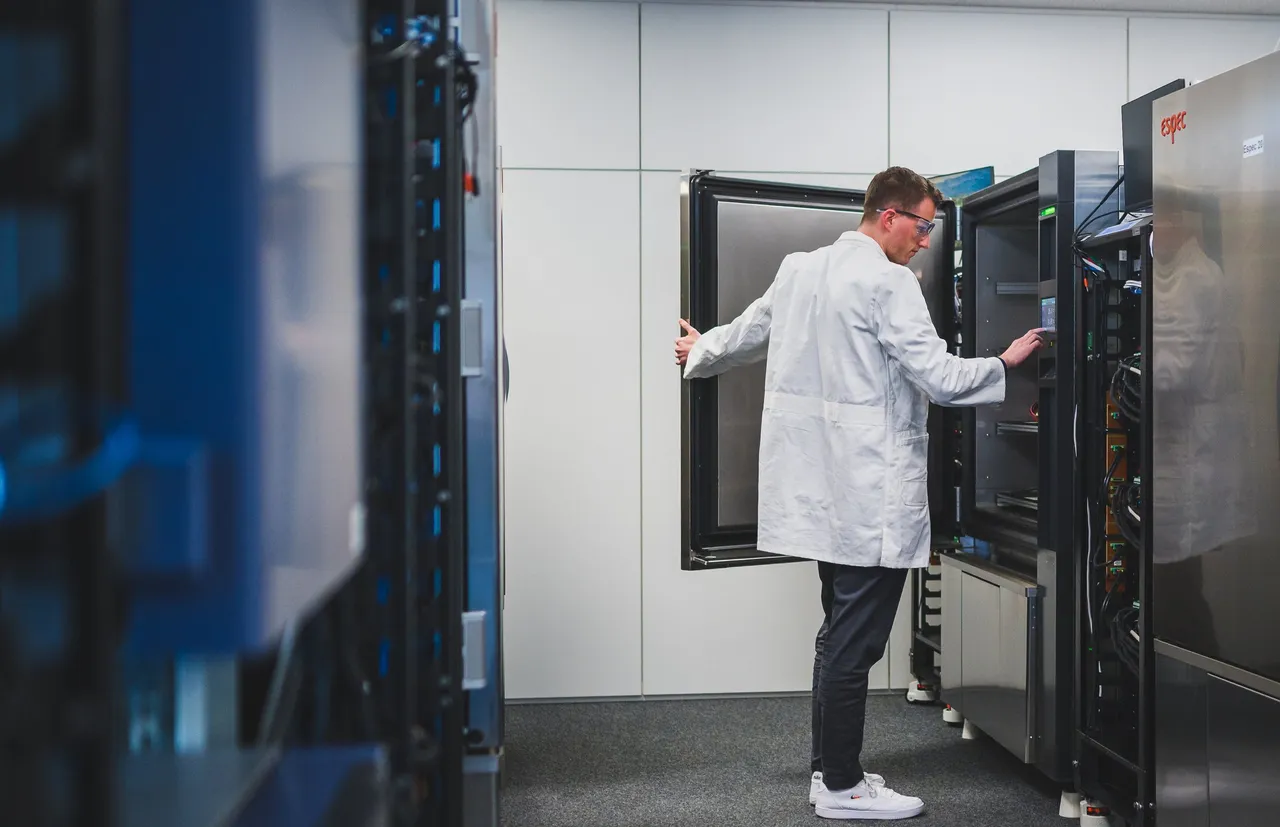
Batemo Cell Data covers the total operating range of a battery cell. Batemo measures every cell in climate chambers, with identical initial and boundary conditions. The thermal boundary condition is free convection. All datasets share the same standardized structure.
This makes the data of different cells directly comparable. Comprehensive documentation is included with every delivery.
Measured operating points
usable energy / Wh
discharge power / W
- State of charge
- 0 to 100 %
- Voltage
- From minimum to maximum voltage
- Current
- Up to the maximum current the cell manufacturer permits, in charge and discharge direction
- Ambient temperature
- −20 °C to 40 °C
- Excitations
- Constant currents, pulsed currents and power profiles
Analyze the data in the Batemo Cell Viewer.
The Batemo Cell Viewer is included with every Batemo Cell Data delivery, free of charge. It is a tool to visualize, analyze and compare the data. You can plot the measured current, voltage and temperatures, or calculated characteristic curves for a better overview.
All graphs are interactive: you can move them, turn the axes and zoom in and out.
Measured pulse response
voltage / V · surface temperature / °C
time / s
- 2.1 A
- 10.5 A
- 21 A
- 31.5 A
Compare cells
Compare the data of up to four cells in one view.
Validate cell models
A validation mode compares measurement and simulation of a Batemo Cell Model in detail.
Export
Export the data to MAT, TXT or CSV and import it into the other tools you work with.
What Batemo Cell Data saves you.
Batemo Cell Data replaces your own cell tests with a finished experimental characterization. You base your decisions on measured data and skip the time and cost of a test campaign.
Better
You make cell decisions with high-quality data of many cells, recorded across the full operating range.
Faster
You do not lose time in the lab. There is no waiting days for a measurement result.
Lower cost
You spend less on testing and on buying sample cells. The measurement data of all cells in the Batemo Cell Explorer is available off the shelf.
Frequently asked questions
What is Batemo Cell Data?
Batemo Cell Data is the full experimental characterization of a battery cell. It contains measurements with constant currents, pulsed currents and power profiles, across the total operating range of the cell. Batemo records the data on high-end test stands with identical conditions for every cell. You get the finished results with documentation and the Batemo Cell Viewer, so you do not have to buy and test sample cells yourself. The Batemo Cell Viewer is a tool to view the data, compare cells and create evaluated overview graphs.
Which operating range does Batemo Cell Data cover?
Batemo Cell Data covers the total operating range of a battery cell. The state of charge runs from 0 to 100 %. Voltage goes from the minimum to the maximum voltage, and temperature from the minimum to the maximum temperature. The current reaches the maximum current in both charge and discharge direction. Some measurements are deliberately out of spec, because Batemo really goes to the physical limits of the cell. Batemo measures every cell with identical initial and boundary conditions, so data of different cells is comparable.
How can I analyze and export Batemo Cell Data?
You analyze Batemo Cell Data in the Batemo Cell Viewer, which is included free of charge. It plots the measured current, voltage and temperatures or calculated characteristic curves, and compares up to four cells. All graphs are interactive. You can also export the data to MAT, TXT or CSV and import it into the tools you already use.
What is the difference between Batemo Cell Data and the Batemo Cell Model?
Batemo Cell Data is the measurement of a cell, and the Batemo Cell Model is a simulation model of it. The data shows how the cell behaved in the experiments Batemo ran across its operating range. The Batemo Cell Model is a physical, parameterized and validated model that you run in your own simulation. The Batemo Cell Viewer compares both in detail, so you can validate the model against the measurement.
Start from your question, not from our product names.
Seven things Batemo delivers. Which one you need depends entirely on what you are trying to find out.
Which cells should I even be looking at?
Measured behavior of every cell in the library, side by side — including what the public Explorer does not show.
Batemo Insights
How will this cell behave in my system?
A physical simulation model of the cell that runs in your own environment, under conditions you have never tested.
Batemo Cell Model
What did this cell actually do on the bench?
The full experimental characterization across the operating range, as measured — plus the viewer to read it.
Batemo Cell Data · you are here
A teardown report: materials, internal construction and safety-relevant findings, without opening a cell yourself.
Batemo Cell Report
Where inside the cell does it get hot?
A spatially resolved model of a sub-volume — local distributions the one-dimensional cell model averages out.
Batemo Cube Model
What happens if I change the cell itself?
Vary design parameters of an existing cell and see the consequence before anyone builds a sample.
Batemo Cell Designer
How does this scale to a module and a pack?
From cell to pack: cooling, mechanics and cost weighed against each other in simulation.
Batemo Pack Designer
Two ways forward.
If you need the decision
Bring us the cell you need measured.
An engineer who has measured these cells reads your message — not a mailbox, and not a sales desk that forwards it.
If you need the data
See which cells are available.
Batemo Insights holds the measured behavior behind every cell in the Batemo Cell Explorer — including what the public Explorer deliberately does not show.
Or start with the measurements — explore the public Batemo Cell Explorer →