Get more out of your system with battery pack simulation
Single-cell measurements do not tell you how the pack will behave.
System optimization gets more out of a battery system: higher peak power, later derating, even temperatures and cooling sized right. Single-cell measurements miss what the pack adds through contact resistances and cells heating each other. Battery pack simulation with a validated Batemo Cell Model predicts it before the first prototype is built.
Talk to a battery engineer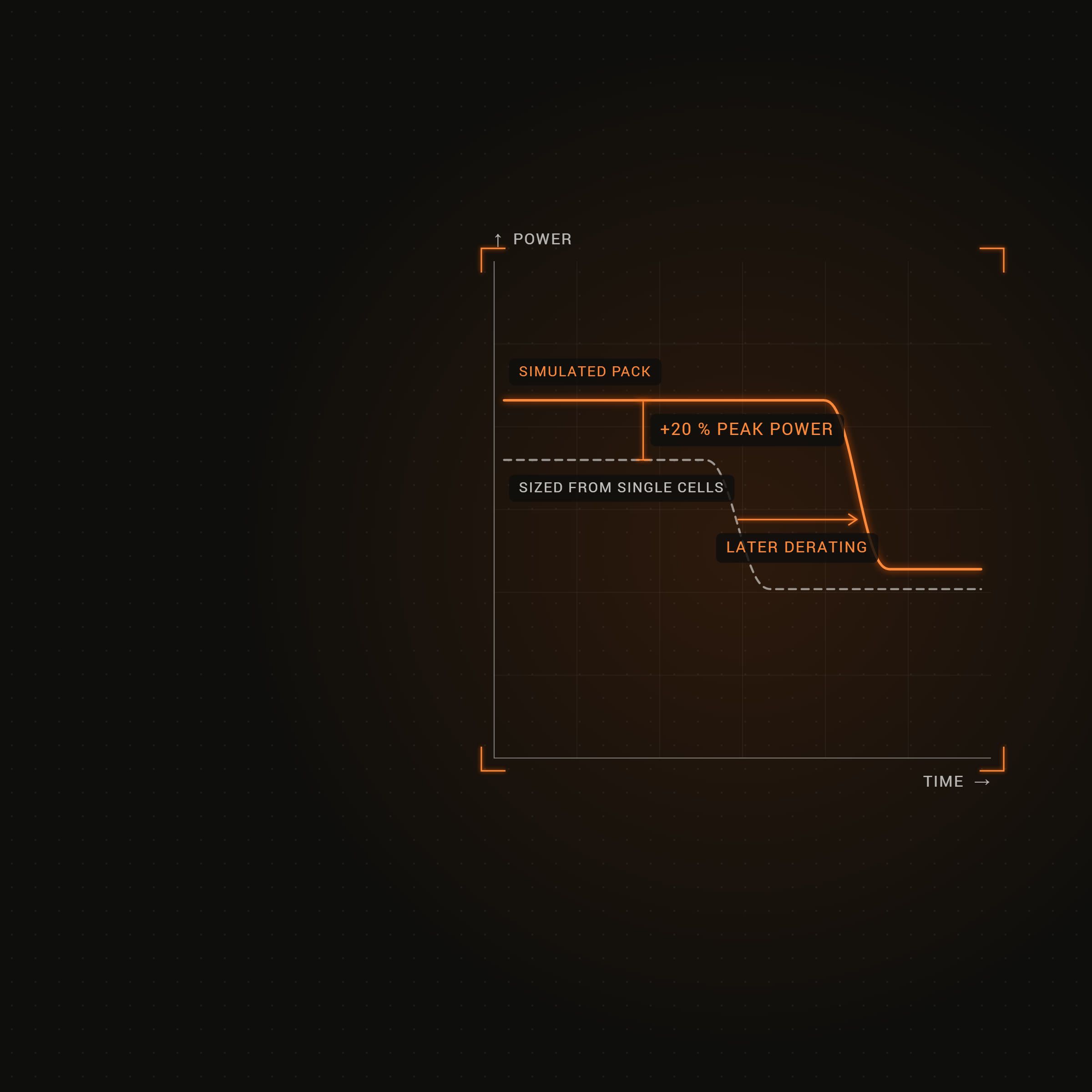
Battery pack simulation: today and with a Batemo Cell Model
Today, a pack is sized from single-cell measurements and corrected on the prototype. With a Batemo Cell Model the pack is simulated first, electrically and thermally, so its potential and its risks show up before anything is built.
Measured vs. Batemo Cell Model
voltage / V · surface temperature / °C
capacity / Ah
- 0.49 A
- 4.93 A
- 9.86 A
- 19.73 A
0.7%
voltage deviation of the model, RMS over all validation tests
0.8K
temperature deviation, RMS
Today
Characterize every cell first.
Before the model exists, each cell needs its own pulse and open-circuit voltage tests at several temperatures.
With a Batemo Cell Model
Start from a validated model.
Pick one of more than 190 models from the Batemo Cell Model Library and start your study the same day.
You gain: 190+validated cell models, ready to start from
Today
Fit an equivalent circuit.
One or two RC pairs reproduce the points they were fitted to and drift at high current, in the cold and at low state of charge.
With a Batemo Cell Model
Describe the physics.
The Batemo Cell Model describes the electrical, chemical and thermal processes inside the cell. Across 198 validated cells the median deviation is 0.8 %. If you can show us another battery cell model that is more accurate, we will refund your money.
You gain: Accuratein the full range of current, temperature and state of charge
Today
Read the pack from single cells.
Single-cell measurements miss what the pack adds: current-path and contact resistances, and cells heating each other. The pack then behaves worse than the cell data promised.
With a Batemo Cell Model
Predict the pack before you build it.
Battery pack simulation adds the electrical and thermal interaction of the cells, so the risk shows up in the model, not in the prototype.
You gain: Less riskthe pack behaves as simulated, not as hoped
Today
Estimate the heat.
A simple heat source misses how heat generation changes with state of charge, temperature and current, so the cooling is sized for a cell that does not exist.
With a Batemo Cell Model
Compute the heat.
The same model predicts the heat the cell dissipates in every operating point, including entropic effects and hysteresis. Where hot spots inside the cell matter, the Batemo Cube Model resolves them.
You gain: One modelfor voltage and heat
Today
Wait for the runs.
Detailed multi-dimensional models are accurate but take hours per run and a lot of engineering time.
With a Batemo Cell Model
Run the study in minutes.
A pack simulation built from Batemo Cell Models runs within minutes on an office computer, so a design study becomes many runs instead of a few.
You gain: Minutesper pack simulation run
Today
Build the pack model alone.
Cells, connections, cooling paths and control are set up by hand, and the first useful result is a long way off.
With a Batemo Cell Model
Get to the pack model faster.
Batemo engineers bring workflows and templates from many pack projects and set up the pack model with you. Batemo is more than software.
You gain: Expertswith workflows and templates from many pack projects
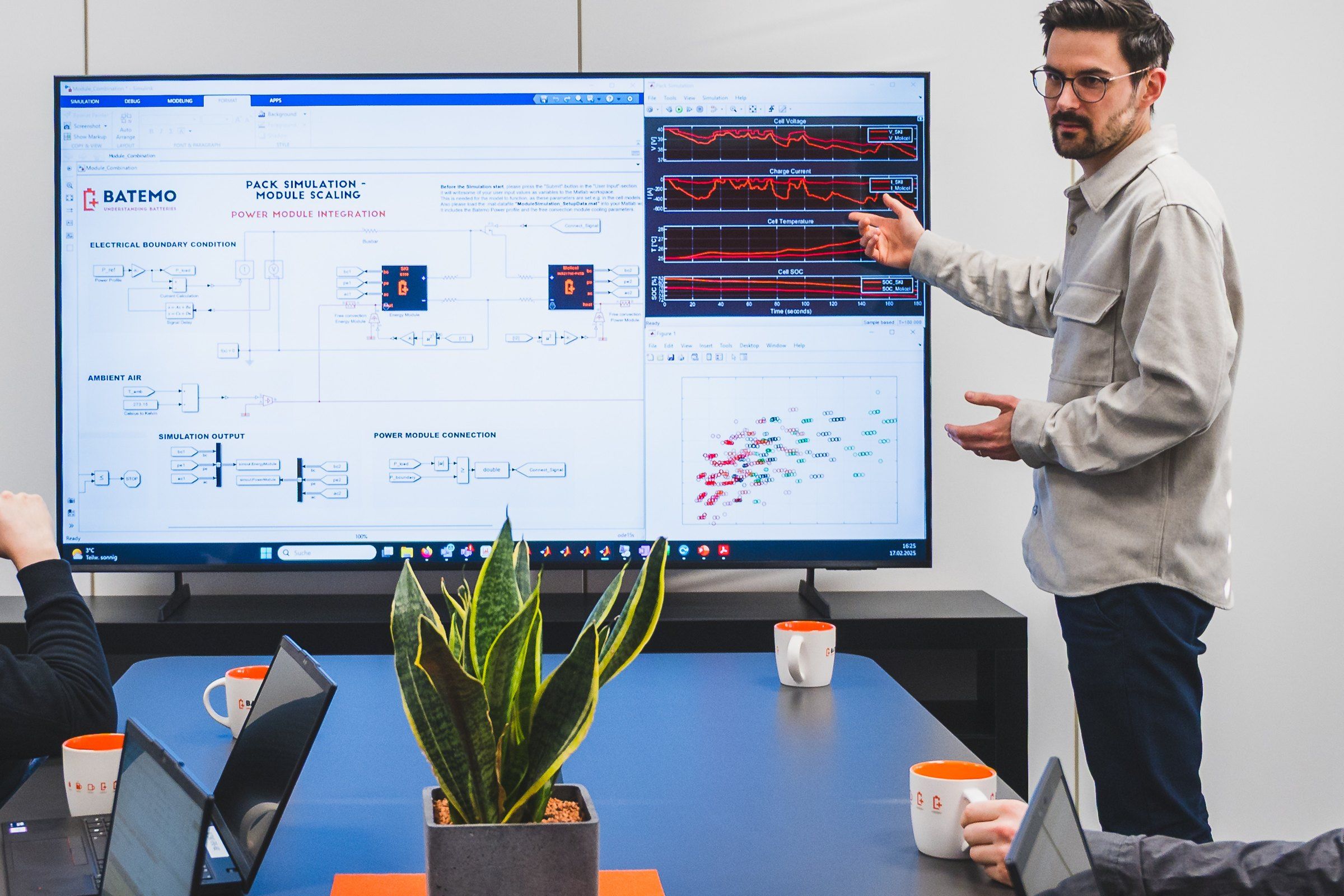
Batemo is more than software
Batemo engineers build the pack model with you, from workflows and templates used in many pack projects. The cell models come validated from the Batemo Cell Model Library.
What system optimization gets you
With a validated cell model inside your pack simulation, you see where your system has reserves and how to use them before hardware is built.
Cell
cylindrical, pouch or prismatic
Module
Pack
+20 %peak power in one project
More peak power
Find the power reserves in your system and use them.
Later derating
Hold full power longer before the system has to throttle.
Better thermal balance
More even temperatures across the pack, fewer hot spots.
Cooling sized right
Neither too small nor too large, which saves weight, space and cost.
Longer lifetime
Account for load and aging in the design, not after it.
A smaller pack
Use the reserves you have instead of adding cells.
Fewer prototypes
Compare variants in the model before hardware is built.
Where is the potential in your system?
Talk to a battery engineer
Questions about battery pack simulation
What is battery pack simulation?
Battery pack simulation predicts how a pack of cells behaves in a system: voltage, current, temperature and state of charge over a duty cycle. Engineers use it to size cooling, set current limits and test control strategies before a prototype exists. Simulation-based development is much faster than building one prototype after another. You can also test far more comprehensively in simulation and so clearly reduce the probability of remaining errors in the current design. The pack model connects cells, thermal paths and control. Its cell model decides whether the result holds.
Why is the cell model as important as the pack model?
The pack model mostly multiplies and connects what the cell model delivers. If the cell voltage is wrong at high current or low temperature, every series connection repeats that error. The same applies to heat: if the heat generation of the cell is wrong, the temperatures of the whole pack are wrong. The inverter, the thermal management and the control read voltage and temperature. A wrong value therefore leads to wrong control decisions, not to a slightly wrong result. Simulations are often about the limit cases, and that is exactly where the cell limits the system. The cell model has to be accurate there. That is what Batemo Cell Models are built for, because other approaches do not work well enough at these limits.
Is an equivalent circuit model good enough for pack simulation?
No. An equivalent circuit model copies the terminal behavior with simple elements. Its structure does not match the physics, and nonlinearities are not handled properly. It reproduces the points it was fitted to and drifts elsewhere. In cold, high-power or aged conditions, the results of the simulation are simply wrong. That is dangerous in system development, because you can no longer rely on your simulations. Equivalent circuit models should therefore not be used in system development.
What is a battery thermal model, and what approach should I take?
A battery thermal model computes how much heat a cell produces and how that heat spreads and leaves the pack. For system questions in the pack, the Batemo Cell Model is the right approach: it predicts the heat dissipation of the cell in every operating point, couples it to the electrical behavior in your system simulation and is accurate enough for almost every question. Only when the temperature inside a cell is strongly unbalanced do you need the Batemo Cube Model, which resolves local hot spots. That is not the standard case, because a good pack design aims at cells that are as thermally homogeneous as possible. The Cube Model is therefore for detailed studies. For a complex pack geometry with coolant flow, the models run in 3D fluid simulation.
Which simulation tools can I use a Batemo Cell Model in?
Batemo Cell Models have built-in integration for MATLAB Simulink, MATLAB Simscape, Simcenter Amesim, AVL CRUISE M, AVL FIRE M, Elements and Hexagon Cradle CFD, and as an FMU they run in all common simulation tools.
How accurate are Batemo Cell Models?
Across 198 validated cells the median model deviation is 0.8 %, measured against validation experiments. Batemo backs its models with a guarantee: if you can show us another battery cell model that is more accurate, we will refund your money. We publish the accuracy of every model on its own cell page on this website, and for every model we provide Excel reports that show its accuracy under the validation conditions in detail.
Two ways to optimize your system
If you need the decision
Bring us the pack and the question it has to answer.
An engineer who has measured these cells reads your message — not a mailbox, and not a sales desk that forwards it.
If you need the data
See the measured cells behind the models.
Batemo Insights holds the measured behavior behind every cell in the Batemo Cell Explorer — including what the public Explorer deliberately does not show.
Or start with the measurements — explore the public Batemo Cell Explorer →