
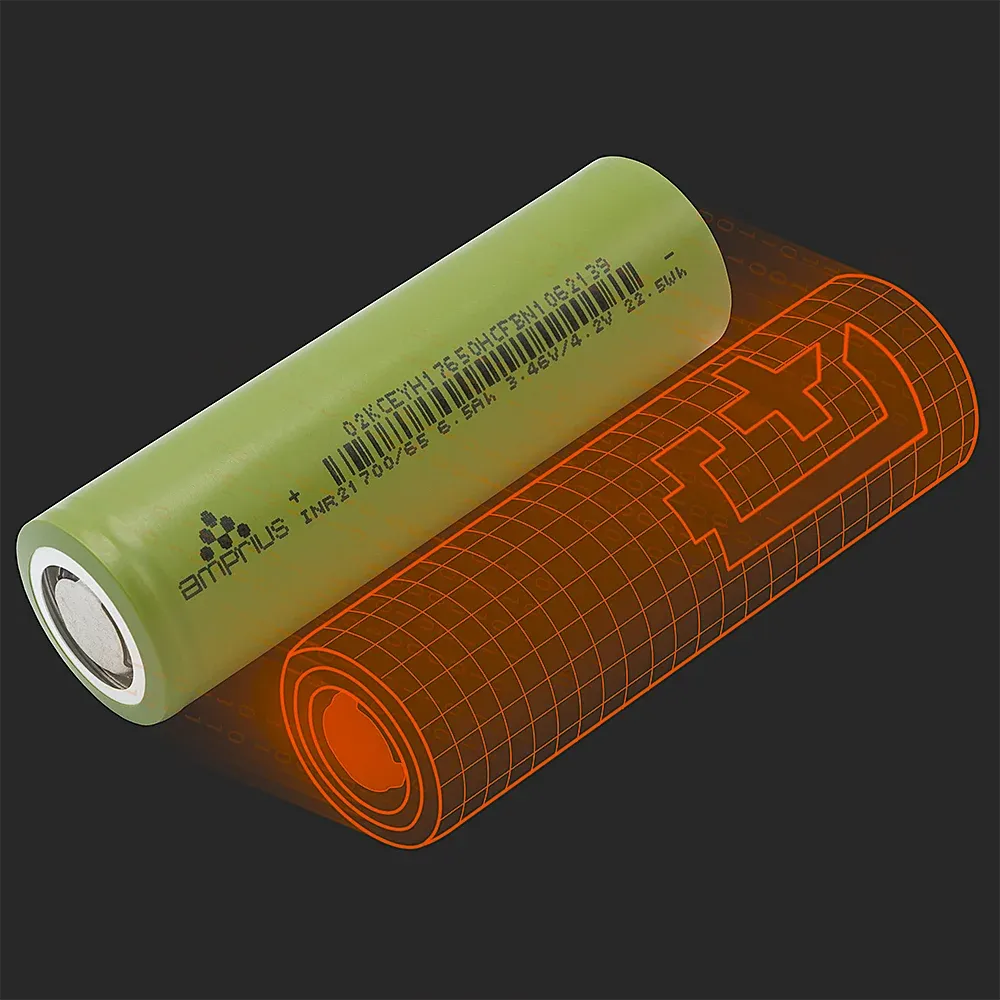
AmpriusSA112

Measured at Batemo: the Amprius SA112 delivers 325 Wh/kg energy density and sustains 28 W continuous power in a 21700 cell.

Opened, measured and modelled at Batemo in Karlsruhe, Germany · 196 measured parameters per cell · not datasheet values

Available asBatemo InsightsBatemo Cell Data

Dimensions
21.4 x 70.9mm
Mass
71.5 g
Internal resistance
(measured at Batemo, available in Batemo Insights)
Spread across a measured batch
(measured at Batemo, available in Batemo Insights)
Amprius SA112: the physical cell next to its Batemo model
The measured cell and its physical model
Amprius SA112
325 Wh/kg · 1,087 W/kg
04,0008,0000250500power, W/kg →energy, Wh/kg →

this cell353 more sample cells

Show all 17 measured values, and 3 more behind the lock

ENERGY

Gravimetric energy (C/10)
?

The energy exchanged during the C/10 discharge described under Capacity, divided by the cell’s mass or volume. Measured directly, not calculated from the nominal capacity. Full definition

325Wh/kg
Volumetric energy (C/10)
?

The energy exchanged during the C/10 discharge described under Capacity, divided by the cell’s mass or volume. Measured directly, not calculated from the nominal capacity. Full definition

910Wh/L
Absolute energy (C/10)
?

The energy exchanged during the C/10 discharge described under Capacity, in watt-hours. Measured directly, not calculated from the nominal capacity. Full definition

23.22Wh

POWER

Gravimetric power, peak
?

The peak or continuous power above, divided by the cell’s mass or volume. Not a datasheet rating: the current behind it was measured on Batemo’s own test benches. Full definition

1,087W/kg
Gravimetric power, continuous
?

The peak or continuous power above, divided by the cell’s mass or volume. Not a datasheet rating: the current behind it was measured on Batemo’s own test benches. Full definition

389W/kg
Volumetric power, peak
?

The peak or continuous power above, divided by the cell’s mass or volume. Not a datasheet rating: the current behind it was measured on Batemo’s own test benches. Full definition

3,048W/L
Volumetric power, continuous
?

The peak or continuous power above, divided by the cell’s mass or volume. Not a datasheet rating: the current behind it was measured on Batemo’s own test benches. Full definition

1,090W/L
Absolute power, peak
?

Peak figures come from the highest current Batemo measured the cell to sustain briefly; continuous figures use the lower current it can sustain without interruption. Both stop at the same 2.5 V / 80 °C condition as the discharge measurements. Full definition

77.7W
Absolute power, continuous
?

Peak figures come from the highest current Batemo measured the cell to sustain briefly; continuous figures use the lower current it can sustain without interruption. Both stop at the same 2.5 V / 80 °C condition as the discharge measurements. Full definition

27.8W

CURRENT

Absolute current, peak
?

The highest constant discharge current Batemo measured the cell to sustain briefly, before the same 2.5 V / 80 °C stop condition applies. Full definition

22.9A
Absolute current, continuous
?

The highest constant discharge current Batemo measured the cell to sustain continuously, before the same 2.5 V / 80 °C stop condition applies. Full definition

8.3A

PHYSICAL

Dimensions
?

Measured on the physical cell at Batemo in Karlsruhe, Germany, not taken from the manufacturer's drawing. Volume is derived from the measured capacity and its volumetric density, not measured with a caliper. Full definition

21.4 x 70.9mm
Mass
?

Measured on the physical cell at Batemo in Karlsruhe, Germany, not taken from the manufacturer's drawing. Volume is derived from the measured capacity and its volumetric density, not measured with a caliper. Full definition

71.5g
Volume
?

Measured on the physical cell at Batemo in Karlsruhe, Germany, not taken from the manufacturer's drawing. Volume is derived from the measured capacity and its volumetric density, not measured with a caliper. Full definition

25.5cm³
Format
?

Measured on the physical cell at Batemo in Karlsruhe, Germany, not taken from the manufacturer's drawing. Volume is derived from the measured capacity and its volumetric density, not measured with a caliper. Full definition

21700

CELL

Absolute capacity, nominal
?

Discharged from a full charge at a constant C/10 current and 25 °C, until the cell reaches 2.5 V or its surface reaches 80 °C. Nominal is the value from the datasheet; measured, gravimetric and volumetric are what Batemo recorded during that discharge. Full definition

6.50Ah
Absolute capacity, measured (C/10)
?

Discharged from a full charge at a constant C/10 current and 25 °C, until the cell reaches 2.5 V or its surface reaches 80 °C. Nominal is the value from the datasheet; measured, gravimetric and volumetric are what Batemo recorded during that discharge. Full definition

6.69Ah
Mean voltage (C/10)
?

The charge-averaged voltage across the same C/10 discharge: the exchanged energy divided by the exchanged charge, not a single number picked from a curve. It is a measured mean, not the nominal voltage printed on a datasheet. Full definition

3.47V

In Batemo Insights

Impedance spectrum (EIS)
(measured at Batemo, available in Batemo Insights)
Heat generation and thermal properties
(measured at Batemo, available in Batemo Insights)
Capacity loss after formation
(measured at Batemo, available in Batemo Insights)

Measured data for the Amprius SA112.

The Amprius SA112 was measured on our own test bench, under the same conditions as every cell in the library. The curves below show how it behaves under load at 25 °C. They are a preview of the full data set. At 1C (the one rate measured on every cell), usable energy is 87% to 99% of what the same cell delivers at C/10.

All three panels below use the same 10 measured operating points, at 25 °C ambient.

energy

10 pts · 25 °C · lin

How much energy can it deliver?

The graph visualizes how much energy the cell can deliver when operated at different powers.

usable energy / Wh

0102004080

discharge power / W

At 25 °C ambient, Amprius SA112 delivers 5.0 Wh at 87 W, down from 23.2 Wh at C/10 (2.3 W).

thermal

10 pts · 25 °C · lin

How hot does it get?

The greater the thermal losses, the more the cell heats up, resulting in higher depleted power.

max. surface temperature / °C

2040608004080

discharge power / W

At 25 °C ambient, Amprius SA112's surface reaches 70.0 °C at 87 W, up from 26.9 °C at C/10 (2.3 W).

runtime

10 pts · 25 °C · log

How long can it deliver the power?

The more power the cell supplies, the shorter it can deliver the power.

runtime to cutoff / s (log)

100100010k100k04080

discharge power / W

At 25 °C ambient, Amprius SA112 runs for 3 min at 87 W, down from 10 h 17 min at C/10 (2.3 W).

The top 3 challenges you face with this cell.

Every cell is a compromise. This cell's own measurements point to three challenges you will face with it. Each one shows the number behind it and where Batemo helps you solve it.

Cell selection

Choosing the right cell

23.22Wh28W

and that is all a datasheet will tell you

Energy

top quarter of 354 cells

Continuous power

lowest quarter of 354 cells

the challenge

The datasheet says 6.50 Ah. But how much does it deliver in your system?

Looking at energy and power alone is not enough. Your duty cycle is neither C/10 nor 1 C, and somewhere in between the ranking between two cells can invert.

More on Cell selection

Fast charging

Charging it fast

0.7C

highest charge rate we tested (profiles above are schematic)

time →

the challenge

22.9 A peak out of a single cell. On the charging side a different limit binds. How do I fast charge it?

CC-CV, stepped, constant power, boosted: every profile trades time against limits inside the cell that move each other. Which one is fastest for this cell, no datasheet says.

More on Fast charging

Lifetime

Making it last

6.69Ah

measured at C/10: the schematic curves above all start here

cycles →

the challenge

This capacity describes the cell at the beginning of its life. How does it change under different operating conditions?

A cycle test tells you what happened under that one test. It does not tell you which mechanism took the capacity away, and it does not tell you what to change.

More on Lifetime

These three are the challenges this cell's own numbers raise. Which of them decides your product is something only your load profile can say, and that is the next question, not this one.

The Batemo Cell Model for the Amprius SA112 is still being built.

The mean accuracies are published as soon as the Batemo Cell Model is finished.

Get the model for this cell

How this cell sits in the field.

Nearest by measured specific energy and power, the two axes of the Ragone map above. Not by chemistry, and not a recommendation. Other numbers, like continuous current, can still differ a lot.

Among the 107 measured 21700 cells in the Batemo library, Amprius SA112 holds rank 1 by gravimetric energy and rank 63 by gravimetric peak power. Against the median of these cells (256 Wh/kg and 1,200 W/kg), its gravimetric energy is +27% and its gravimetric peak power is −9%. With 3.3 W of peak power per Wh of energy, it is in the quarter of these cells with the lowest power-to-energy ratio, so it leans towards an energy cell.

The two closest cells in the library

Also close · 11% apart

Far East Battery (FEB) 21700-62E

21700
  • Gravimetric energy299 Wh/kg-7.8%
  • Gravimetric power, peak1,022 W/kg-6.0%
  • Absolute current, continuous10.2 A+23.2%
  • Mass73 g+2.6%
Open cell page
This cell at the center of a map of specific energy (horizontal) and specific peak power (vertical). Same build + closest behaviour: Far East Battery (FEB) 21700G-68E(C), 4.9% apart. Also close: Far East Battery (FEB) 21700-62E, 11% apart.×1.50×0.67×1.50×0.67energy →power ↑10%25%

Ring percentages measure overall distance, energy and power combined. The ×-numbers on the dashed box measure just one axis: a point on that edge has that many times this cell's own specific energy or power.

  • This cell
  • Other cells, same build, in window

Same build + closest behaviour · 4.9% apart

Far East Battery (FEB) 21700G-68E(C)

21700
  • Gravimetric energy311 Wh/kg-4.3%
  • Gravimetric power, peak1,107 W/kg+1.8%
  • Absolute current, continuous11.4 A+37.4%
  • Mass73 g+2.7%
Open cell page

More cells close to this one

What do you need for the Amprius SA112?

Ion, our battery decision assistant, joins this page after launch. Until then, these go straight to the engineers who measured this cell.

Get model and dataCompare cells